GRANDVILLE, Mich. (WZZM) – A West Michigan man’s remarkable approach is revolutionizing horse training around the world. He teaches people to speak to horses and has been able to turn previously-untrainable horses into show horses. Now, Jordan Brasser’s method is taught around the world, including in Hollywood.
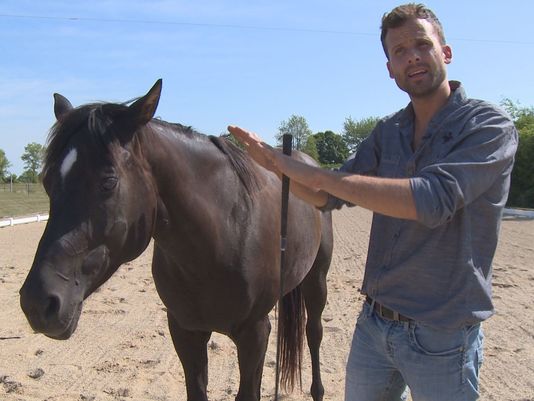
At a Grandville horse ranch, Brasser is quickly filling up horse pens with people wanting to learn his method and use his space. He already has two other horse ranches that are full. The 22-year-old is a horse behaviorist. In other words, he tries to learn what a horse is thinking in order to then train the horse accordingly.
One of his prized horses is Calypso. “This horse started out being hyper-sensitive,” explained Brasser, “bucking people off and bolting.” Calypso was getting to the point that she was threatening people’s lives. She went through multiple trainers in one year. In the end, she was so challenging she was given to Brasser.
Brasser put his unique training style to work with Calypso. “What I like to do with people,” Brasser said, “I like to emphasize connection with horses, getting them to have that bond that doesn’t break.” He tests his bond with Calypso by forgoing a bridle, and takes the halter off in the middle of an unfenced horse arena.
“How about you just feel motivated to want to be here,” Brasser said to Calypso. The horse stays at his side. When Brasser walks forward, the horse walks forward. When he jogs away, the horse jogs away. The horse just knows where she needs to be.
Brasser jumps on the bareback horse, and without reins, gallops around the arena, communicating to the horse using leg pressure.
At an early age, Brasser loved horses, he says. “I showed an unusual desire at the age of 8 to want to understand horse behavior.”
He learned with some of the best horse behaviorists in the world, and now he teaches his Jordan Brasser method around the world. “I am national and now international. Twice a year, I get to go to Germany.” He spends time in the Netherlands and Indonesia, too.
He methods buck tradition and emphasize body language. “Horses speak to each other in body language,” he explained. “I can then go out to any horse, and whatever their past is, give them a future.”
He shows off what not to do with a horse, pushing the horse around the arena. “We’re going to go here,” Brasser demonstrated. “Move, move, move. Now back up, back up, back up; if we communicate to our horses like that, it is kind of like always yelling.”
Instead, he uses reverse psychology to help the horses understand what he wants them to do.
He’s often hired to work with troubled horses and takes them from unteachable to riding them in a day. He puts on shows demonstrating how a stubborn horse can learn in less than an hour.
“A lot of the industry is traditional, traditional, traditional,” Brasser said. “That is all everyone has to study, because that is the education that is out there, and that is primarily what is happening.” He’s trying to change that. “I am trying to tell them that it is faster and more efficient and a stronger training program to first understand the horse’s head and mind before approaching performance fundamentals.”
He now trains others to be trainers, and even goes to Hollywood to be the horse trainer on movie sets, “to understand a little bit the value of the language with horses — instead of creating a robot with buttons that is just obedient and submissive. To create something even better than that. Let your horse express themselves, but with you.”