Your heart rate starts to climb, your palms begin to sweat, your blood pressure is through the roof, and you start to feel the nausea kick in, but it’s too late to turn back now. This is your moment; either you control it, or let it control you.
What is horse show anxiety?
Horse show anxiety is simply a more specific term for Performance Anxiety within a competition-oriented equine environment. Performance anxiety are the raw symptoms that a performer or athlete goes through prior to their performance or competition. If unmanaged, the anxiety can alter the actual performance of the athlete.
Why do some people get horse show anxiety and other people don’t?
This is a falsified question; everyone who competes in any sport experiences performance anxiety. No matter how famous you are, or how much experience you have, you will always experience anxiety. Performance anxiety is a side-effect of a competitive challenge. If you aren’t experiencing anxiety, then you aren’t challenging yourself. The reason that people assume that some do not experience these symptoms is because they know to to control it.
Understanding Performance Anxiety
Do you know what performance anxiety really is? A mind game. It is a trick that your mind plays on your body. Some people experience such high levels of anxiety that they go into full panic attacks and experience heart-attack related feelings and experiences. This is not a body issue, this a mind issue. Your mind has tricked your body into feeling nervous, scared, in danger, and worrisome about the outcome. Even though you say you are in no immediate danger and you’re not scared, you can’t hide from your subconscious mind. The human mind is so advanced that it can physically trick the body into feeling something that isn’t real. How powerful is that? It is captivating.
What does it mean to “control” anxiety?
To manipulate your body and mind to cancel out the unwanted effects of a stressful situation. Army snipers sit behind the lines of enemy territories for days surrounded by enemy soldiers who would happy to kill them, but the anxiety doesn’t stop them from nailing a 700 yard target with precision. Why is that? Because they know how to control their anxiety. Sure, a sniper is more physically fit than most of us, but physique is irrelevant to mental strength. Put the strongest man in America in a sniper hole and they will completely freak out. These snipers are trained to deal with anxiety, and you can use the same concepts to apply to your life. Like they say in sports, “success is 80% mental and 20% physical”. The mental aspect is what separates the great from the “okay”.
Keep in mind (no pun intended) that the body isn’t stupid either, you can actually use your body to control your mind. (Take that, mind!) Below I have listed some ways to control your anxiety and to help you get through your competitions without being hindered by false symptoms caused by anxiety.
1) Learn to breathe
Probably the best piece of advice anyone will give to you concerning performance anxiety is to breathe! In a nerve-wrecking situation, you’re probably breathing shallow and much faster than you would when you are at home on the couch. You can recycle and slow down your breathing in just a few short minutes, and you’ll start to feel a relief from the anxiety.
How to: take a big deep breath through your nose until your lungs are full and you cannot breathe in any more. Then release the air through your mouth slowly until you cannot exhale any more. Count each breathe, and do this continuously. Once you count to about 30 – you’ll start to feel a major release, and you will be thanking me. Try it and see for yourself.
2) Focus
Don’t concentrate on the crowd, the possibility of failure, what this show is worth to you, or what could happen. These types of surroundings are part of the landscape, and are actually distracting you from getting to your goal, wether you know it or not. You need to create the “tunnel vision effect” that you see in movies, where you are so focused on one thing that you forget everything around you. Some methods people use are counting to 100 and then back down again and going to your “happy place” in your mind where you feel safe, such as your home. The more you practice this, the easier it will become and the more effective it will be. Don’t let the landscape of a physical location destroy you. You don’t want to look back after your run and realize that you failed because you were too worried about the shining lights and cameras, do you?
3) Fight fire with fire
A quick way to relieve tension is to create tension. This new tension will release you from your old tension. Try tightening and releasing your muscles one at a time, starting with your fingers. Do this with your arms, legs, toes and feet as well. This is an old trick, and is extremely effective at not only releasing tension, but also to defer your focus from the thoughts that are causing you anxiety. (point #2).
4) Mental Preparation
Mental preparation is the trump card for dealing with performance anxiety. This is what will eliminate the initial anxiety because you’ve already mentally prepared for any type of outcome and how to react to it. This is usually done days or weeks prior to an event and takes serious focus to master. You can have all of the tricks to deal with the buildup of anxiety, but to stop that buildup from happening is a different story. Play every event out in your head of what could, would, and should happen. From that point you need to plan how you will react to each situation, should it occur. Once you’ve played this out in your head enough, you will have mentally trained yourself to deal with any situation. The truth is that when Murphy’s law is able to show its ugly face, it will, and you need to be prepared for it. If you really care about stopping performance anxiety, then you need to do your own mental homework.
5) Stop using anxiety medication for Performance Anxiety!!
If you legitimately have anxiety problems outside of your sport, then take your medication…that’s fine. Medication is not the answer though, the answer is within you. Using prescription drugs as a way to hide the effects of anxiety can be related to owning a dog; when the dog uses your carpet as a toilet, you can clean up the mess or put a paper towel to cover it. Sooner or later you are going to run out of paper towels (and friends), and then you’re going to have to deal with a very nasty situation. The same applies here. Everyone gets anxiety, and everyone feels potential threats, danger, and unfavorable outcomes as a possibility in whatever they do. This is normal! Performance anxiety is 100% normal. This guide is to learn how to control your anxiety, not to eliminate it. You never want to eliminate anxiety, because anxiety is the “rush” of doing something great. Taking Xanax or beta-blockers before performing will absolutely destroy your performance without a doubt. Xanax and beta-blockers will turn you into a zombie; no worries, no problems, and a dull feeling. This is not normal. If you’re in a high-tense environment and you are too relaxed, you will not reach your expectations. To use an example, picture Mike Tyson in the ring with a major fighter; chances are, Mike anxious, but he is ready and prepared to fight. Now, image taking that same situation, but instead putting Mike Tyson in the ring when he just woke up out of bed. He would most likely lost the fight. The point being that the feeling of anxiousness is what drives you to compete, it is the conquering of that anxiety that makes you a better and stronger person. Taking drugs are the weak person’s way of escaping the situation, and if you want to escape the situation, then go home, because you’re wasting everyone’s time. If you aren’t serious about what you’re doing, then thats fine…do whatever you want to do, but if you are here because you want to be better, then quit masking the truth. Be a fighter and deal with your problems, don’t let them deal with you.
Conclusion
The bottom line is that anxiety is not caused by your surroundings…it is caused by you. You create your own anxiety, everyone does. The trick is to learn how to cope with it. Everyone is different, and therefore everyone has their own way of dealing with the infamous “fight or flight” responses their body gives them. If you’re serious about improving your career, you will take anxiety very seriously, as usually it will cause more harm to your performance than good.
Anxiety and Hockey – My story.
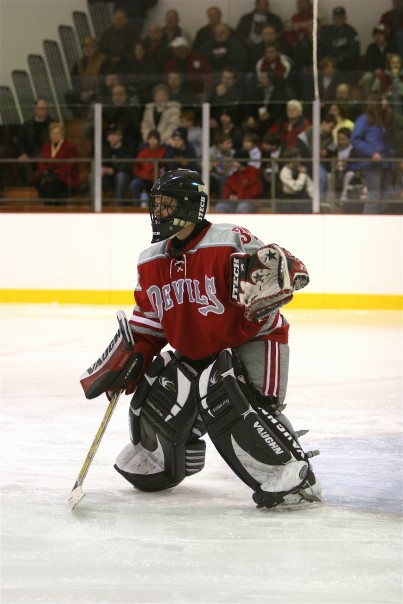
From the age of 8 years old, I was addicted to playing ice hockey and I was living in the ice arenas throughout Michigan. As I matured as a goaltender and as a person, I developed performance anxiety that had an effect on my performance without a doubt, but I taught myself how to control it. As a goaltender, you are the last line of defense, the backbone of the team, and wether it is your fault to not if someone scores, you are blamed by every eye in the building. Competing at a AAA level for many years (which is the highest ranking hockey divisions in the US for that age group) as well as High School, and College is not only difficult physically, but is very demanding mentally. To know that if your team loses, not only are you to blame; but 10,000 other people feel the same way. In these high levels of hockey, you do not have 2nd chances. If you blow your cool, you probably will never see a game again. This creates some pretty heavy anxiety, and I needed to learn to accept it as well as deal with it.
As I started to advance into tougher divisions I had to be able to control the effects of the challenges in front of me. I would mentally prepare myself days in advance for everything and anything that could possibly go wrong and how I would deal with it. I would use stretching and breathing exercises before going onto the ice. I would be completely in my own zone before games; if you were talking to me, I wasn’t seeing, listening, or hearing you in any way…I was concentrating on the task at hand. Many people say to be an ice hockey goalie, you have to be a little bit crazy, and I agree. Unlike forwards and defensemen, goalies are usually shifted the responsibility of the victory or the loss, and if you aren’t mentally ready for that kind of punishment, there are hundreds and thousands of other people who would kill to take that job off of your hands.
Now my hockey career is over, but I have achieved many high rankings throughout my career in AAA, High School, and College. I have played for prestigious head coaches such as the father of Sergei Federov. I have won VIP awards in 32 of the 34 teams that I have played for in my life. I accredit much of my success to the hard work, training, and mental preparation that goes along with assuming one of the most cut-throat and anxiety-ridden positions in all of sports…the goalie.